
Which account to spend first in retirement
Much of the tax code is a list of ways to owe less: here's what you owe, and here are all the ways you can qualify to owe less, in thousands of pages. Retirees can often use this list to their advantage over several years, in a way that isn't obvious.
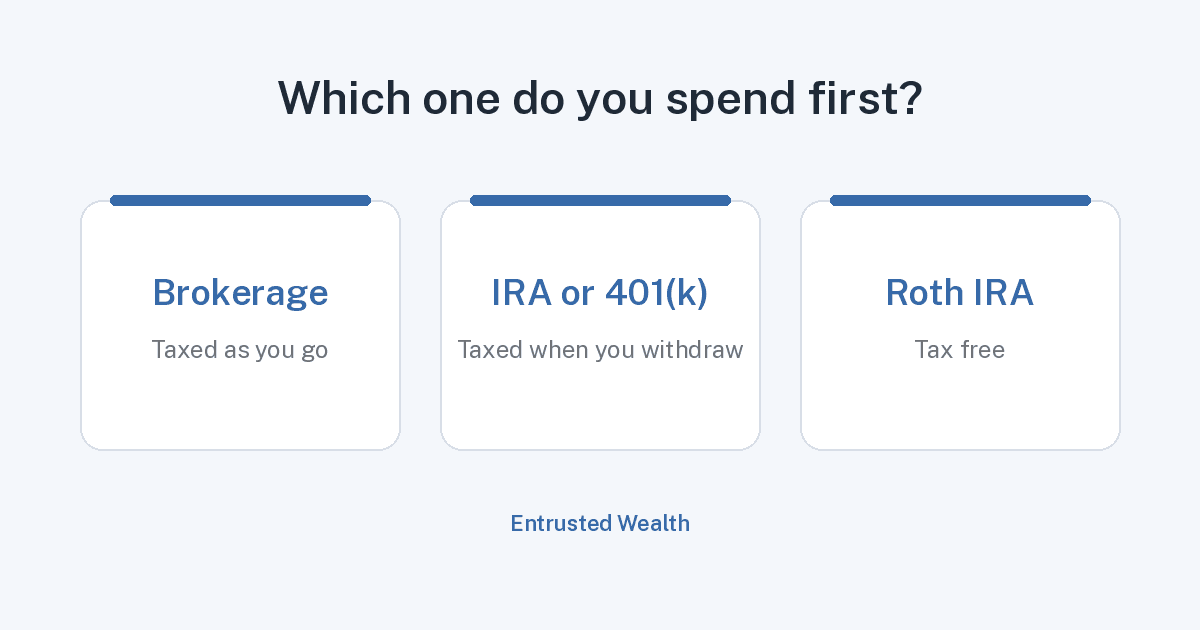
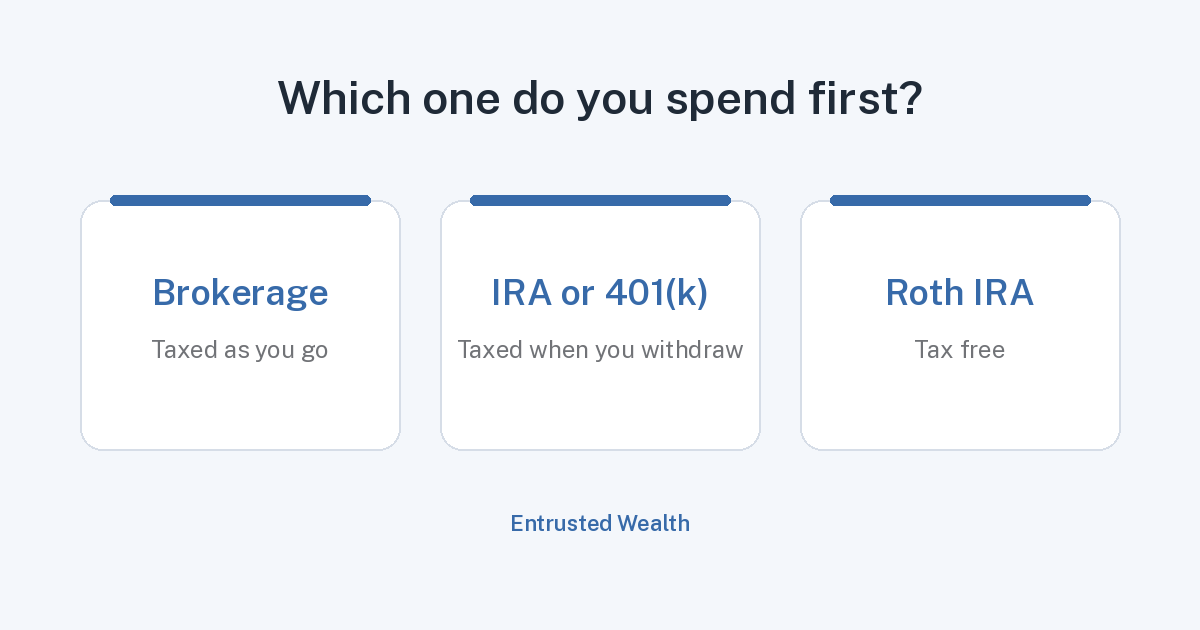
The standard advice for drawing down retirement savings typically goes like this: spend from taxable accounts first, then tax-deferred accounts like IRAs, then Roth (tax free) accounts last. The rationale is fairly straightforward: every year the IRA stays untouched is another year of tax-deferred growth, and the Roth, which is never taxed again, should compound the longest.
Followed strictly, it tends to produce a suboptimal pattern. The first years of retirement show almost no taxable income. A retiree or retired couple may have a brokerage account and some excess cash to live on, pulling from each for living expenses, so their early taxable income is almost nothing at all. Then required distributions begin, at 73 or 75 depending on birth year, usually alongside Social Security. The result is a high-tax period following a near-zero one, a dramatic shift. Compounding this is the effect of the IRA accounts' untouched growth during that time period, making those required distributions even higher. A good problem to have, to be sure, but an expensive one.
The case for paying tax early
Every year brings a reset to your tax bracket. If the goal is to pay the lowest amount of tax in aggregate over a lifetime, paying near zero in your early retirement years sounds like a win. But if you flip your thinking, paying near zero also means you are letting an opportunity to unlock "cheap" income pass you by every New Year's. It's like a coupon for something expensive that expires every December 31. A new one arrives in January, but last year's is gone for good.
To unlock cheap income, you simply have to take it. It might sound strange in retirement, since you no longer have "earned" income, but there are usually plenty of opportunities to take "unearned" income like IRA distributions, capital gains, and Roth conversions. This means paying tax now at rates that may never be this low again. Paying tax intentionally runs against every instinct most people have. But the reality is, without proper planning, so much income stacks up in later years that you may end up paying disproportionately high taxes. Below are a few examples:
Required distributions are not optional. Once they begin, the IRA sets your income, and a large one can push you into brackets you never saw while working.
Medicare premiums rise with income. Above certain thresholds a surcharge applies to Parts B and D, based on your tax return from two years earlier.
Couples eventually become single filers. When one partner dies, the survivor usually keeps most of the household income but moves to single brackets, which are roughly half as wide. An IRA that was manageable for two can become expensive for one.
Lifetime tax should be the focus
A better goal is to aim for paying the lowest total tax over all retirement years, factoring in what a surviving spouse and heirs will pay. Children who inherit an IRA generally have to empty it within ten years (and pay the resulting taxes), often during their own peak earning years.
In practice, that usually means drawing from more than one account at a time, in proportions that shift as the years go by. Some years call for a set IRA withdrawal sized to fill a bracket. Some call for a Roth conversion instead, and some may even call for doing nothing.
The right strategy...depends
The right mix depends on how large the IRA is relative to everything else, when Social Security starts, whether health insurance before 65 is subsidized based on income, your charitable intent, and where you live. Two households with the same net worth can land on different answers.
The health insurance point deserves its own warning. For anyone buying marketplace coverage before Medicare, income that looks cheap in tax terms can cost far more in lost premium credits, which is worth a post of its own (coming soon).
Where this falls through the cracks
The window for this closes every December 31, and it usually falls between two jobs. A tax preparer records the year accurately once it's over. A portfolio manager who never sees the tax return can't size a withdrawal to a bracket. It takes someone looking at both at once to get it right.
If you're a few years from retirement or in the early years of it, find the taxable income line on last year's return and see which bracket it landed in. If it's the 10% or 12% bracket, there's a good chance "cheap" income is going unused. For anyone with a large IRA, even the 22% bracket can be cheaper than what's waiting later.
This post is general education, not tax or investment advice for your situation. Talk with your tax professional before acting on any of it.